
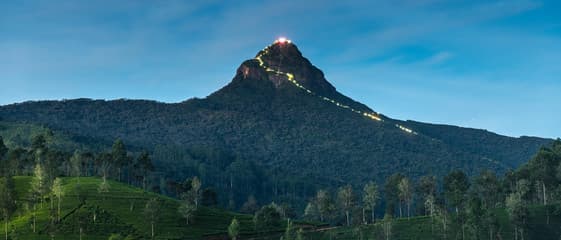
Few climbs anywhere combine what Adam's Peak does. You start in the dark somewhere around two in the morning, join a river of pilgrims moving up a lit stairway, and arrive at a small summit shrine as the sky turns. Then, if the air is clear, the mountain throws a perfect triangular shadow across the cloud below — the reason people have been making this climb for well over a thousand years. This guide covers the season, the routes, and what the ascent actually asks of you.
Key Takeaways
- The pilgrimage season runs from the Unduvap full moon in December to Vesak in May
- Outside that window the stairway is unlit and the shelters are closed — do not climb alone
- The standard route from Nallathanniya is roughly 5,500 steps and takes three to four hours up
- Start climbing around 2:00am to reach the summit comfortably before sunrise
- The summit is cold and windy — bring far more warm clothing than the coast suggests
- Weekends and poya days are extremely busy, with queues on the upper steps
- The descent is harder on the knees than the ascent — take it slowly
A Mountain Sacred to Four Religions
At the summit of Sri Pada sits a rock formation shaped like a large footprint, and it is claimed by four faiths at once.
Buddhists hold it to be the footprint of the Buddha, left on his third visit to the island. Hindus attribute it to Shiva. Muslim and Christian tradition identifies it as the footprint of Adam, taking his first step after leaving Eden — which is where the English name comes from.
The result is one of the few genuinely shared pilgrimage sites in the world, and it gives the climb an atmosphere no ordinary trek has. You will be walking among families, elderly pilgrims making the ascent slowly over many hours, and groups of teenagers treating it as a night out. It is a religious act for most of the people around you, and worth approaching in that spirit.
The Season Is Fixed, and It Matters
Adam's Peak has a defined pilgrimage season that overrides every other consideration.
| Period | Status | What to Expect |
|---|---|---|
| December (Unduvap poya) to May (Vesak poya) | Open season | Stairway lit all night, tea stalls open, shelters staffed |
| June to November | Off season | No lighting, stalls closed, path wet and slippery |
During the season the entire route is illuminated, small tea shops sell sweet tea and snacks along the way, and there are people on the path at every hour of the night. It is safe, sociable and well supported.
Outside the season the mountain is a different proposition — an unlit staircase in the dark, frequently in cloud, with nobody around and nothing open. It can be done with an experienced local guide and proper lighting, but it is not a casual undertaking and it is not what this guide describes.
For how the season fits alongside the rest of the travel calendar, see our guide to the best time to visit Sri Lanka.
Choosing Your Route
There are several approaches. Almost every visitor uses the first.
| Route | Start Point | Steps | Time Up | Difficulty |
|---|---|---|---|---|
| Nallathanniya (Dalhousie) | Nallathanniya village | About 5,500 | 3–4 hours | Standard route, steep but straightforward |
| Palabaddala | Near Ratnapura | Considerably more | 6–8 hours | Long, quieter, much harder |
| Kuruwita | Kuruwita | Longest | 8–10 hours | Rarely used by visitors |
Nallathanniya is the right choice for almost everyone. It is the shortest route, the best lit, the best supplied with tea stalls, and the easiest to reach — it is a short drive from Hatton, which is on the main hill country rail line.
The Palabaddala route is genuinely beautiful and far quieter, but it roughly doubles the climb and should only be considered if you are a confident hill walker with a guide.
Timing the Climb for Sunrise
The whole point is to be at the top when the sun comes up, and the timing is unforgiving in one direction — arrive late and you have missed it.
| Time | Stage |
|---|---|
| 1:30am | Wake, dress, drink something warm |
| 2:00–2:30am | Begin the climb from Nallathanniya |
| 4:30–5:30am | Reach the summit area |
| 5:30–6:00am | Wait, get cold, find a spot |
| Around 6:15am | Sunrise |
| 6:45am | Begin the descent |
| 9:30–10:30am | Back at the bottom |
Start at 2:00am on a normal weekday. On a weekend or a poya day start closer to 1:00am, because the upper section develops genuine queues and the last few hundred steps can take an hour on their own.
Arriving an hour before sunrise sounds excessive until you are there. The summit platform is small, the good positions fill, and you will want somewhere to stand rather than shuffling in a crowd.
How Hard Is It Really?
Honest answer: harder than most people expect, but achievable for anyone reasonably fit who takes it slowly.
There is no scrambling, no exposure and no technical difficulty. It is a staircase, from bottom to top. What makes it demanding is the sheer relentlessness — thousands of steps of varying height, steepening considerably in the final third, done in the middle of the night after little or no sleep.
The descent surprises people. Going down five and a half thousand steps on tired legs puts far more strain on the knees than the ascent does, and it is where most injuries happen. Take it slowly, use the handrails, and expect it to take nearly as long as going up.
Children manage it regularly, as do pilgrims well into their seventies. Pace, not fitness, is the deciding factor.
What to Bring
The summit is genuinely cold — often between 5°C and 10°C with a hard wind — and you will be sitting still in it for an hour after climbing in a sweat.
- Warm layers, more than you think, including something windproof
- Hat and gloves — unglamorous and completely justified at the top
- Head torch, even in season, for the stretches between lights
- Shoes with grip; the steps are worn smooth and often damp
- Water, though tea stalls along the route sell drinks
- Cash in small notes for tea and the donation boxes
- A light towel — you will sweat on the way up and then chill at the top
Leave the heavy pack behind. Every extra kilogram is felt on the last thousand steps.
Etiquette at the Summit
This is an active place of worship, and a few things are expected of visitors.
- Remove your shoes before entering the shrine area at the top
- Dress modestly — shoulders and knees covered, as at any temple
- The bell near the summit is rung once by pilgrims for each completed ascent. If you have climbed once, ring it once.
- Keep noise down during morning worship
- Do not push for position at sunrise; people around you may have been climbing for six hours
The Shadow of the Peak
Shortly after sunrise, when conditions are right, the mountain casts a near-perfect triangular shadow onto the cloud and haze to the west. It appears to hang in the air, detached from the ground, and then slowly shortens and disappears within about twenty minutes.
It needs clear air and low cloud below the summit, so it is not guaranteed on any given morning. It is most likely in the drier months from January to March.
Where to Stay Before the Climb
Stay in Nallathanniya itself. There is a cluster of simple guesthouses at the base, and they are used to guests checking in during the afternoon, sleeping early and leaving at two in the morning. Most will hold your room until you return and let you sleep and shower afterwards — confirm that when booking.
The alternative is Hatton, about forty minutes away, which has better accommodation but adds a drive at one in the morning to the front of an already short night.
Hatton is on the Kandy to Ella railway line, so Adam's Peak slots into a hill country leg without a long detour. Our 14-day Sri Lanka itinerary builds in the extra time it needs.
The climb is a set piece of our adventure tours, which pair it with Horton Plains, the Kitulgala rapids and the Ella trails across a fortnight.
Plan Your Climb
With the season and route settled, the next steps are fitting the climb into your wider route:
- 14 Days in Sri Lanka: The Complete Itinerary — where the climb fits in a longer trip
- Sri Lanka in December — the month the season opens
- Ella to Kandy Train Journey — the rail line that reaches Hatton
- Best Time to Visit Sri Lanka — everything in one place